

1. The Lie Everyone Believes
It’s a new age.
The best part: anyone can build anything.
The worst part: anyone can build anything.
People think you can just prompt an LLM, get code, and ship something real. And at first, it feels true.
It works for demos.
It breaks for anything that actually matters.
This isn’t about standing out. It’s about getting something that works at all.
2. How to start “Vibe Coding”
To get started, download an IDE (Integrated development environment) of your choice, which is basically an app on your computer that will link to your folder with all your code.
Examples: VSCODE (microsoft), Cursor, Antigravity (Google)
Then once you download it use file → point at your folder.
Let’s say you want to build a simple to-do app.
Vibe coding approach:
“Build me a to-do app with login and saving tasks”
You’ll get something, for this it might work, but for more complicated things it may break, and you won’t understand why.
Better approach:
Ask: “What are the parts of a to-do app?”
Decide: login, task list, storage
Build one piece at a time
Same tool. Completely different result.
3. Treating LLMs Like Employees
LLMs are not magic.
They behave like junior employees:
They follow instructions (if you give them clearly)
They don’t understand your system unless you explain it
They will confidently do the wrong thing if you ask poorly
If you treat them like a tool that “just builds everything,” you’ll get chaos.
If you treat them like an engineer you’re managing, you get leverage.
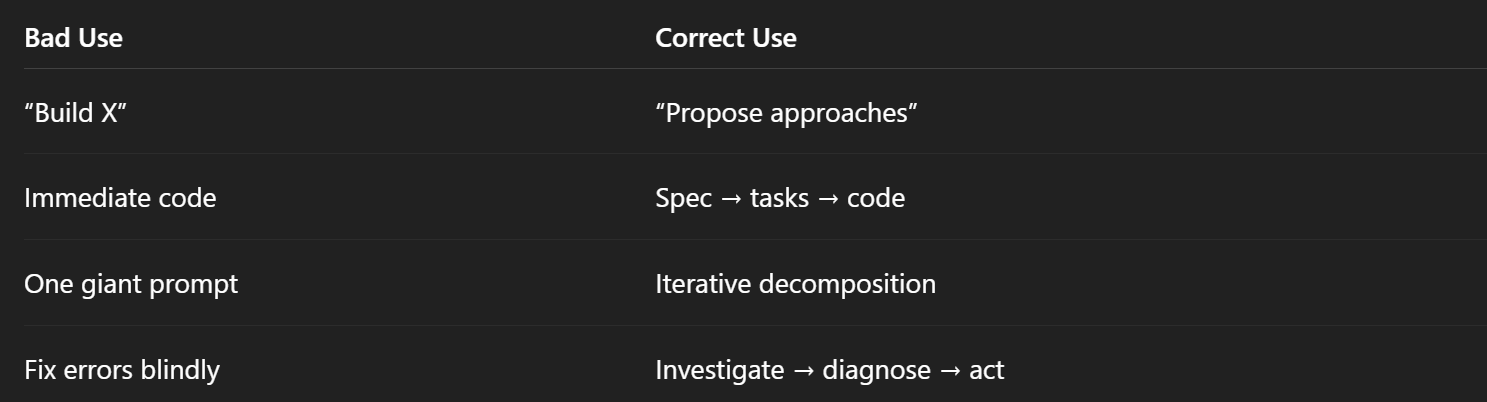
4. The Actual Workflow (Step-by-Step)
Problem/Goal explanation (clear + detailed)
Ask for approaches (no code)
Choose approach + tradeoffs
Convert to spec (what you want to make)
Break into tasks
Execute task-by-task
Code generation is the final step, not the first.
5. The Failure Modes (Where People Get Stuck)
5.1 Constant Refactors
Caused by skipping planning
Fix: Plan out what you actually want, write/scribble it anywhere you want, draw it on a blank piece of paper, whatever work for you.
5.2 Lack of Context
You can’t summarize a book you haven’t read, much less explain the implication of the window in chapter 3.
Fix: Add a master doc/read me that is incredibly detailed (the model can do this for you, and also help you switch models/providers if you ever need to)
5.3 Doom Loops
“Fix this” → random changes → worse state
Fix: Ask it to explain what the problem is, instead of asking it to fix things. If applicable ask if there is a better way.
5.4 Complexity Collapse
Asking for too much at once
Fix: Break it down, if you really want a bunch at once make sure to use planning mode.
6. Why This Works
Basically the key to success is setting realistic expectations, it’s like cooking, you don’t just throw everything in at once (unless it’s super simple)
Beginners think LLMs replace thinking.
They don’t.
They amplify it.
If you rely on them to do everything, you get fragile systems.
If you guide them properly, you get leverage.
Good luck building!